Welcome to the Synergy Properties Blog!

Whether you're a happy homeowner, looking to sell your current home, or searching for the home of your dreams, the Synergy Properties team has curated some helpful blog posts to help provide inspiration for your next DIY project, catch up on your real estate knowledge, or answer your hard-hitting questions about the home selling/buying process. Sift through our blog categories and feel free to let us know if you'd like us to cover something in particular. Happy reading!


April 13, 2020

Why You Should Avoid "For Sale by Owner"


Rising home prices coupled with the current inventory in today’s market may cause some homeowners to consider selling their homes on their own (known in the industry as a For Sale By Owner). However, a FSBO might be hard to execute well for the vast majority of sellers.

Here are the top 5 reasons not to FSBO:

1. Online Strategy for Prospective Purchasers

Studies have shown that 93% of buyers search online for a home. That’s a pretty staggering number! Most real estate agents have an Internet strategy to promote the sale of your home. Do you?

2. Results Come from the Internet

According to NAR, here’s where buyers found the homes they actually purchased:

  1. 55% on the Internet
  2. 28% from a Real Estate Agent
  3. 10% Other
  4. 6% from a Yard Sign
  5. 1% from Newspapers

The days of selling your house by putting up a sign in your yard or placing an ad in the paper are long gone. Having a strong Internet strategy is crucial.

3. There Are Too Many People to Negotiate With

Here’s a list of some of the people with whom you must be prepared to negotiate if you decide to FSBO:

  1. The buyer, who wants the best deal possible
  2. The buyer’s agent, who solely represents the best interest of the buyer
  3. The buyer’s attorney (in some parts of the country)
  4. The home inspection companies, which work for the buyer and will almost always find some problems with the house
  5. The appraiser, if there is a question of value

4. FSBOing Has Become Increasingly Difficult

The paperwork involved in buying or selling a home has increased dramatically as industry disclosures and regulations have become mandatory. This is one of the reasons the percentage of people FSBOing has dropped from 19% to 8% over the last 20+ years.

5. You Net More Money When Using an Agent

Many homeowners believe they’ll save the real estate commission by selling on their own, but the seller and buyer can’t both save the commission.

A report by Zillow revealed that FSBOs are inclined to do so because they believe it will save money (46 percent cite this among their top three reasons), but they don’t actually save anything, and eventually end up listing with an agent.

The same report revealed that,

“While 36% of sellers that (at first) attempted to sell their homes on their own, only 11 percent of sellers—in other words, less than a third…actually sold without an agent.”

It appears working with a real estate professional is the best answer.

Seller Resources:


Posted in Seller Blog
April 7, 2020

Growing Demand for Small Homes


Movies, tv shows, and celebrities often have us dreaming of owning large homes, but the reality for most people is quite different.

Since 2015, the square footage of newly built houses has been shrinking, according to Yahoo Finances. This is not projected to change as we continue into the beginning of the year.

“We expect this downsizing trend to continue in 2020, driven by a confluence of economic and demographic trends.”

Why are smaller homes trending now?

As noted in the article, there are a few reasons for this demand:

  1. “Many of today’s younger, millennial home buyers have expressed a preference for denser, more urban homes that are more walkable to shared amenities.”
  2. “Today’s older homeowners are expressing a desire for smaller, less maintenance-heavy and more accessible (read: less stairs) homes as they age and move into newer homes.”

With these two demographic groups surging through the market, the demand for this type of home is rising. If you’re a homeowner with a smaller-scale house, now may be a great time to sell, as the demand for this end of the market is surely on the rise.

Seller Resources:


Posted in Seller Blog
April 6, 2020

3 Must do Items Before Buying a Home


The homebuying process can be daunting, whether its your first real estate purchase or not. Here are a few things you can do to set yourself up for sucess prior to purchasing a home:

  1. The first thing you’ll want to do in the home buying process is to interview several agents. Make sure they’ve had some experience and actually sold some homes over the past 12 months. Look at the reviews from their past clients. By doing your due diligence and selecting someone with expertise, you’ll save yourself a lot of money in the process. 
  2. Secondly, I recommend you get pre-approval from a lender. It’s a huge first step toward purchasing a home. Understanding what you qualify for and what you can afford will give you an idea of what type of houses you can buy. 
  3. Lastly, make sure you have a time frame. If you’re currently renting, you’ll want to give yourself enough time to fulfill that lease and leave a 30-day window to move into your new home (on average, it takes about 30 days for a house to close, so keep that in mind). 

If you have more questions on how to prepare for a home purchase or want to know more about any other real estate topic, please give us a call or shoot an email. We’d love to hear from you. 

Buyer Resources:


Posted in Buyer Blog
April 4, 2020

5,300 Reasons to Be Happy You’re a Homeowner


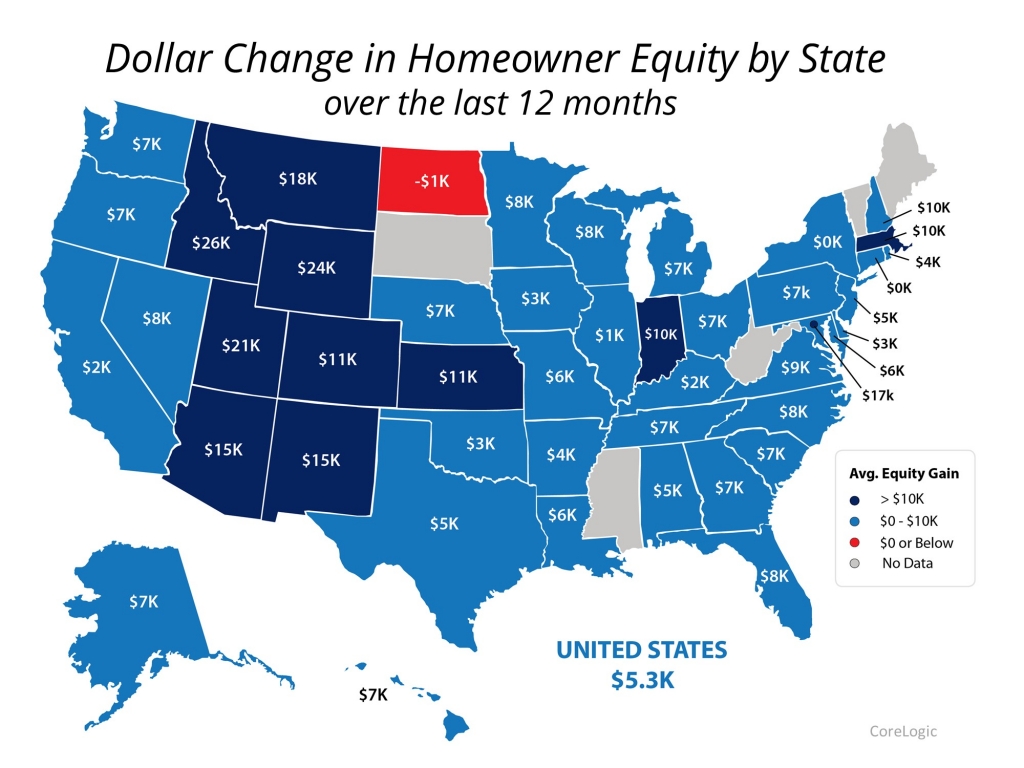
Studies have shown that, in many cases, the largest asset a family owns is the house they live in. Over the last twelve months, that asset has gained substantial value.

CoreLogic released their Homeowner Equity Insights Report which revealed that: “U.S. homeowners with mortgages (roughly 64% of all properties) have seen their equity increase by a total of nearly $457 billion since the third quarter 2018, an increase of 5.1%, year over year.”

The equity in a property is determined by comparing the current value of the property against the outstanding mortgage debt. As prices rise, the equity in a home increases.

The report went on to explain that the average homeowner gain in equity over the last twelve months was $5,300.

The map above shows the average equity gain by state. Since the housing crash in 2008, many homeowners have felt trapped in their current houses, as they didn’t have enough equity to sell. The gains in equity over the past few years may have freed some homeowners who have a desire to move.

If you’re curious about your home’s equity, let’s get together to do a market analysis on the current value of your house. You may be pleasantly surprised.

Client Resources:


Posted in General Blog
April 1, 2020

April 2020 Newsletter

Posted in Synergy Newsletter
March 29, 2020

Which is More Important: Offer Terms or Price?


When it comes to submitting a winning offer, price isn’t everything. In fact, the terms you include also play a major role in an offer’s success. 

In this market, it isn’t about price, but the risk to the seller. Sellers want to feel secure in knowing an offer will hold up and the transaction will be able to proceed smoothly. 

One of the offers we submitted on behalf of a client recently won out as a result of its terms. There were six offers on the table, including one $20,000 higher than ours. But the seller was willing to overlook the difference in price because our offer lacked an inspection contingency. Given that the home wasn’t in the best shape, this presented a major benefit to them. 

The seller in this situation understood that the money they might earn from a higher-priced offer was still not a match for the value we were offering through our offer’s terms. 

Appraisal buffers are another example of how terms can sometimes dominate over price. Our team recently worked with a buyer who had a little bit of extra cash. Rather than putting all of this money down, we added an appraisal buffer to the offer. An appraisal buffer is essentially the assurance that if the appraisal comes in low, the buyer will offer a set amount of cash to supplement the difference. This helps to give sellers peace of mind. 

And if the appraisal doesn’t come in low, the buffer offer won’t come into play. In our situation, this was exactly the case. The appraisal buffer didn’t cost our buyer a thing, and they were able to secure a deal for $10,000 less than the top offer on the table. 

Financing is another important aspect of any offer. If waiving financing altogether is feasible, this can be an attractive option. However, this wasn’t necessary in our case, nor is it necessary in all cases in general. 

In the example of a recent transaction we carried out, we had our buyer fully underwritten so that the lender could verify all the buyer’s financial credibility. Being able to show the seller that you are pre-approved will greatly boost your chances as a buyer. 

For most sellers, having a smooth transaction is more important than earning the highest price. Price makes up just one line of an offer, while the terms make up the remaining 20 or so pages. If you have an understanding of how to make your offer’s terms more attractive to the seller, you won’t need to pay the top price to strike a deal. 

If you have any other questions or would like more information, feel free to give us a call or send us an email. We look forward to hearing from you soon.

Buyer Resources:


Posted in Buyer Blog
March 27, 2020

Staging May Help You Sell Your Home Faster


Some Highlights:

  1. The National Association of Realtors surveyed their members and released the findings of their Profile of Home Staging.
  2. 62% of seller’s agents say that staging a home decreases the amount of time a home spends on the market.
  3. 50% of staged homes saw a 1-10% increase in dollar-value offers from buyers.
  4. 77% of buyer’s agents said staging made it easier for buyers to visualize the home as their own.
  5. The top rooms to stage in order to attract more buyers are the living room, master bedroom, kitchen, and dining room.

Seller Resources:


Posted in Seller Blog
March 25, 2020

Real Estate Reality Show Myths Debunked


Have you ever been flipping through the channels, only to find yourself glued to the couch in an HGTV binge session? We’ve all been there, watching entire seasons of “Love it or List it,” “Million Dollar Listing,” “House Hunters,” “Property Brothers,” and so many more all in one sitting.

When you’re in the middle of your real estate themed show marathon, you might start to think that everything you see on TV must be how it works in real life, but you may need a reality check.

Reality TV Show Myths vs. Real Life

Myth #1

Buyers look at 3 homes and decide to purchase one of them.

Truth: There may be buyers who fall in love and buy the first home they see, but according to the National Association of Realtors the average homebuyer tours 10 homes as a part of their search.  

Myth #2

The houses the buyers are touring are still for sale.

Truth: Everything is staged for TV. Many of the homes being shown are already sold and are off the market. 

Myth #3

The buyers haven’t made a purchase decision yet.

Truth: Since there is no way to show the entire buying process in a 30-minute show, TV producers often choose buyers who are further along in the process and have already chosen a home to buy. 

Myth #4

If you list your home for sale, it will ALWAYS sell at the open house.

Truth: Of course, this would be great! Open houses are important to guarantee the most exposure to buyers in your area but are only a PIECE of the overall marketing of your home. Keep in mind that many homes are sold during regular listing appointments as well. 

Myth #5

Homeowners decide to sell their homes after a 5-minute conversation.

Truth: Similar to the buyers portrayed on the shows, many of the sellers have already spent hours deliberating the decision to list their homes and move on with their lives/goals.

Bottom Line

Having an experienced professional on your side while navigating the real estate market is the best way to guarantee that you can make the home of your dreams a reality!

Client Resources:


Posted in General Blog
March 17, 2020

Why Should I Purchase a Home Inspection?


Home inspections are an important part of every real estate transaction. Today, we want to give you a little more insight into how the inspection fits into the home buying process.

A home inspection helps the buyer understand the condition of the home and its systems. The inspection will reveal where those systems are at in their lifecycle and identify any items that will cost you money to repair or replace in the short and long run.

Inspections are generally done with a professional, licensed inspector. The cost varies from $250 to $600 depending on the size and value of the home.

A critical factor in every winning offer is when you should actually do the inspection. In a market like Seattle's, homes have review dates within 10 days of hitting the market. As a result, we recommend that you pre-inspect the home, especially if you are serious about winning the home in a multiple-offer situation.

By ordering an inspection before you make an offer, you remove the inspection contingency and make your offer more appealing to the seller. You will also know what you are getting into because you know what the cost and condition of that home is, and you can make your offer based on that information.

There are some instances where a home does not have a review date. To save yourself some money, wait until you are under contract on a home to do the inspection. Give yourself a five to 10-day window to perform that inspection. From there, you will decide which repairs you need to ask for.

We do not recommend waiving the inspection. There are cases when buyers try to do that. It’s really a risk-assessment decision for that buyer. You need to understand what the worst case scenario is.

If you waive the inspection, you won’t know much about the house going into the purchase, so your offer price will not be dependent on your knowledge about the house. If something pops up after you buy the home, then it’s up to you to repair the problem.

A lot of times, people choose to waive the inspection because they do not want to pay for an inspection. It is actually much more costly to waive an inspection and then find something wrong with the house than it is to pay a couple hundred dollars for the inspection in the first place.

Hopefully, you now have a better idea of how important home inspections are.

If you have any more questions or would like more information about our current market, just give us a call or send us an email. We would be happy to help you!

Buyer Resources:


Posted in Buyer Blog
March 15, 2020

4 Tips for Choosing a Listing Agent


Today I want to discuss how to choose a listing agent to sell your home. Selling your home is a major life event, and while there are many different factors to consider, four main things will help you best differentiate one agent from the next.

1. Personality Fit

Don’t simply choose the first person you find. If you don’t connect well with your agent, chances are you’re not going to have a good working relationship. That includes making sure your communication styles match, you feel understood and heard by them, you feel good about the process, and they know what’s important to you. If you say “no” to one of these, then this isn’t the right agent for you. 

2. Marketing and Sales Plan

Most agents will place a “For Sale” sign in your yard, put your home on the MLS, then wait for the phone to ring. This is not an adequate strategy for getting top dollar in this market. Basic items for a sales and marketing plan include brochures, staging, photography, and a digital video tour of some kind. You want to be sure your agent takes the extra step of launching an email and phone campaign so they’re getting your house in front of as many buyers and agents as possible.

3. Valuation and Negotiation Skills

Valuing a property is an art form, and unfortunately, most agents aren’t very good at it. Be sure they’re comparing sales of homes similar to and close by yours. They should be looking at sales as far back as six months. That will give you an accurate estimate of what the market will provide for your house. 

You also need to make sure whatever agent you choose has a positive track record of high-level negotiations. This will be crucial when it comes to multiple-offer situations. You want an agent that can put together a deal that works for both sides. 

4. Pricing

Beware of the agent that offers you the highest sales price with the lowest commission. Like in every other area of life, you get what you pay for. If you don’t want to spend much in commission, don’t expect much effort or a marketing plan. Paying commission ensures the full range of services. 

If you have further questions about choosing an agent, or if we can help you in any way, please reach out by phone or email. I would love to hear from you. 

Seller Resources:


Posted in Seller Blog